we shares analysis, strategies on digital marketing everyday.
This service is not intended for persons residing in the E.U. By clicking subscribe, I agree to receive news updates and promotional material from Thrive Media SG
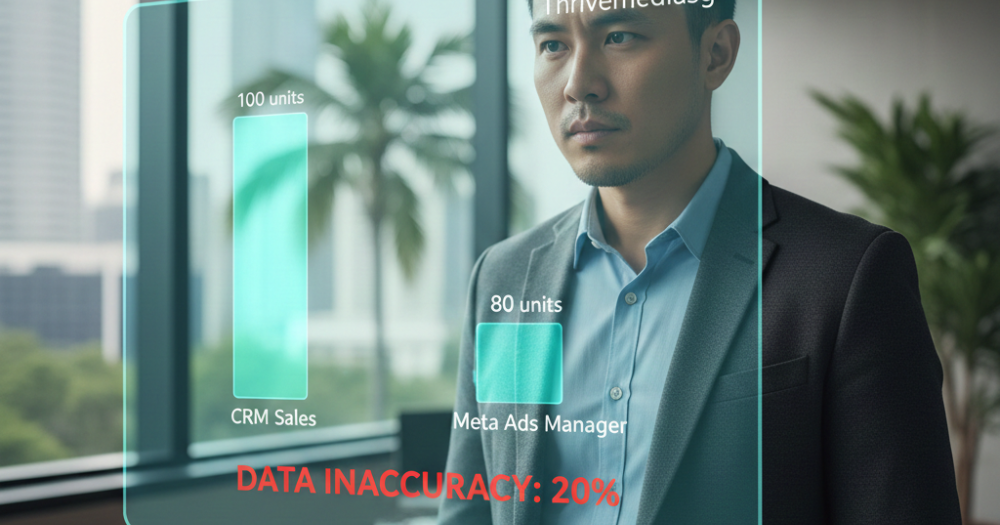
Are you seeing a disheartening gap between your Meta Ads Manager report and your actual CRM sales data? That missing 20% of sales isn’t just a rounding error; it’s a direct threat to your Max Profitable CAC strategy. The root cause is a trifecta of client-side tracking failures: the post-iOS privacy landscape, rampant ad blocker usage, and the inevitable failure of a pure-Pixel setup. The good news? The solution is not only available, but essential: implementing the Meta Conversions API (CAPI). This powerful server-side solution is the definitive fix, ensuring your data is complete, accurate, and ready to drive smarter, more profitable ad spend.
For too long, the humble Facebook Pixel was the cornerstone of ad tracking. It was easy to implement, worked reliably, and gave Meta’s algorithm the clear signals it needed. But the digital privacy revolution, starting with Apple’s iOS 14.5 update and compounded by user behavior, has effectively rendered the client-side Pixel an unreliable historian. This is why your conversion data is a leaky bucket.
Apple’s App Tracking Transparency (ATT) framework gave users the choice to opt out of being tracked across apps and websites. In Singapore, where mobile penetration is exceptionally high, the opt-out rate has a massive impact.
It’s not just Apple; a growing number of savvy web users, particularly younger, tech-conscious audiences, employ ad blockers and privacy extensions.
Even without explicit blocking, the standard Pixel setup is inherently prone to failure. Network latency, slow page loading, browser crashes, or the user closing the tab too quickly can prevent the Pixel script from fully loading and firing the conversion event.
Connect with our expert team with proven digital marketing strategies that deliver real results.
Connect with us! →The challenge of inaccurate tracking isn’t just about messy reports; it has a direct, detrimental impact on your core profitability metric: Max Profitable CAC (Customer Acquisition Cost).
As we discuss in our cornerstone article, Max Profitable CAC, your profitability is based on spending up to a defined limit to acquire a customer. If your tracking is under-reporting conversions by 20%, Meta’s algorithm receives skewed data and makes bad decisions.
Case Study: Singapore B2B Service Provider
A Singapore-based B2B consulting firm was tracking ‘Lead’ events (form submissions) with a pure-Pixel setup. Their internal CRM showed a Cost Per Qualified Lead (CPQL) of S$150. However, Ads Manager was reporting S$180. The S$30 difference meant the algorithm saw the campaign as less efficient than it truly was. Consequently, Meta:
By fixing the tracking, the firm unlocked a lower, more accurate $150 CPQL, allowing them to confidently increase their budget and scale their ad spend without violating their Max Profitable CAC threshold.
CAPI is not a ‘nice-to-have,’ it is a necessary infrastructure upgrade.
Instead of relying on a user’s browser, which is compromised by privacy controls and ad blockers, the Meta Conversions API (CAPI) sends conversion data directly from your secure server to Meta’s server.
Feature | Pixel (Client-Side) | CAPI (Server-Side) | Outcome |
|---|---|---|---|
Data Source | User’s browser | Your secure server/CRM | Bypasses browser restrictions |
Reliability | Low (Blocked by iOS/Ad Blockers) | High (Direct server-to-server) | Ensures near-100% data delivery |
Data Quality | Limited PII, generic match | Rich PII (Hashed Email/Phone) | Boosts Event Match Quality |
By setting up CAPI, perhaps even using a solution like Google Tag Manager Server-Side to Send Hashed Data, you close the data gap and feed Meta the complete, high-quality signals it needs for efficient ad delivery. This is the difference between blindly guessing and making data-driven decisions that respect your profit margins.







Our team consists of seasoned digital marketers, bringing years of hands-on expertise driving results for SMEs and enterprises throughout the APAC region.
from first click to final sale, across Meta, Google, TikTok, YouTube, and your CRM so you can see what’s working and what’s not.
Your videos, landing pages, ads, and data are aligned under one strategy no more juggling vendors.
Budgets shift based on real-time performance, not monthly meetings.
Leads and traffic you already have get optimized for higher ROI and less waste.
Clear reports, honest feedback, and no jargon, even when results aren’t perfect.
Digital Marketing isn’t just about running ads. It’s about turning data into visible growth.
In the competitive Singaporean market, accurate tracking is non-negotiable, especially where Customer Acquisition Costs (CAC) are already high.
The ad auction in Singapore is notoriously competitive. Average Google Ads CPCs for high-intent B2B keywords or finance/legal services often range from S$4.00 to S$10.00+. On Meta, the average CPC can be 49% higher than the global benchmark, with higher volatility, according to Superads data.
When a single click costs this much, losing track of a conversion is a significant financial setback. For a B2B service in the CBD area, a Cost Per Qualified Lead (CPQL) can easily hit S$150–S$300. If 20% of these valuable leads are lost to tracking inaccuracy, you are essentially paying an extra 25% for every accurately tracked lead.
Actionable Insight for Singapore SMEs: Stop treating the Conversions API as a future project. If you are running high-ticket services, such as education (preschools) or financial services, ensure you are not just tracking ‘Lead’ events. Optimise for high-value events like ‘Tour Booked’ or ‘Application Started’ using CAPI, as detailed in CAPI for Singapore’s Preschools. Your competitors who do this will out-optimize you every time.
Max Profitable CAC: Maximizing Singaporean Ad Strategy
The **Max Profitable Customer Acquisition Cost (CAC)** is the absolute highest amount you can spend to acquire a customer while still maintaining a healthy, desired profit margin. It is crucial for Singapore businesses with high ad costs to define this limit, as exceeding it guarantees a cash-flow crisis, irrespective of gross revenue, making sustainable growth impossible.
The industry standard LTV:CAC ratio is generally $3:1$ (meaning a customer's lifetime value is three times their acquisition cost). For businesses in competitive, high-growth Southeast Asian markets, aiming for a **$4:1$ ratio** provides a necessary buffer against rising ad costs and currency fluctuations, ensuring scalable profit.
A longer sales cycle, common in B2B or high-ticket B2C in Singapore, means a longer **CAC Payback Period**. This increases the internal cost of capital. You must factor this higher risk and delayed revenue into your Max Profitable CAC calculation, possibly lowering the maximum acceptable cost to protect immediate cash flow.
For a true, comprehensive calculation of Max Profitable CAC, **yes**. The calculation must be fully loaded, including all sales and marketing costs, such as ad spend, agency fees, and sales team compensation. This holistic view ensures you know the true cost of acquiring a new customer, which is critical for making budget decisions.
To optimize across platforms, focus on sending high-value events (like 'Qualified Lead') via **server-side methods** (like Offline Conversions for Google and CAPI for Meta). This ensures both algorithms are trained on your most valuable customers, driving down the overall Max Profitable CAC across your full-funnel strategy.
CPA is the actual cost to acquire a customer. **Max Profitable CAC is the target maximum cost**, which is calculated backward from your Customer Lifetime Value (LTV) and desired profit margin. A simple CPA doesn't consider long-term customer value, which is vital for high-ticket services common in the Singapore B2B sector.
Yes, absolutely. High-quality data from **CAPI** ensures Meta's algorithm sees every conversion, allowing it to better optimise ad delivery. This efficiency reduces the CPA for high-value events, effectively lowering your actual Cost Per Acquisition and keeping it well below your Max Profitable CAC threshold, enabling scalable performance.
The difference is primarily due to **tracking inaccuracy**, driven by iOS privacy restrictions, ad blockers, and the inherent limitations of the Pixel. CAPI fixes this by sending server-side data directly, recovering the $10-20\%$ of conversions the Pixel missed, which in turn leads to a lower, more accurate, and more profitable CAC in your Meta reports.
No. An extremely low CAC may indicate you are **under-spending in a profitable channel** or only acquiring low-value customers. The goal is not the lowest CAC, but the **Max Profitable CAC**, which prioritizes the highest volume of profitable customers, supporting scale.
Focus on monitoring your **Marginal CAC** (the cost to acquire the next customer) alongside your CPQL (Cost Per Qualified Lead). When the Marginal CAC starts trending upward and nearing your Max Profitable CAC, it’s an immediate signal to adjust creative, targeting, or budget before profitability is compromised.

Your business deserves more. Let ThriveMediaSG help your business Increase Sales through digital marketing.
The Meta Conversions API (CAPI) is a server-side tracking tool that is now the foundational technology for accurate measurement on Meta (Facebook and Instagram). It allows businesses to send conversion events directly from their secure server or CRM system to Meta’s server.
CAPI matters because the traditional Meta Pixel, which relies on a user’s web browser, has become unreliable. Privacy controls like Apple’s iOS 14.5 App Tracking Transparency (ATT) and the widespread use of ad blockers intercept and block the Pixel’s data transmission.
This leads to a phenomenon called conversion under-reporting, where 10-30% of actual sales and leads are missed in Meta’s Ads Manager. CAPI bypasses these browser-level restrictions entirely. It secures a high-fidelity data connection directly between your back-end system and Meta’s optimization engine.
The CAPI solution is critical for any founder or operator running paid acquisition campaigns, especially those relying on the Max Profitable CAC framework for sustainable growth. Without CAPI, your Cost Per Acquisition (CPA) in Ads Manager is inflated, your ROAS is inaccurate, and Meta’s algorithm is fundamentally misinformed.
CAPI operates on a cause-and-effect principle:
Outcome (Deduplication & Optimization): Your server forwards the conversion data to Meta via CAPI. Meta receives two data points for the same event: a potentially incomplete Pixel event and the complete CAPI event. Meta uses the matching event_id to deduplicate the data, ensuring the conversion is only counted once. This accurate, high-quality signal is then used to train the ad delivery algorithm.
Accurate tracking is built upon three pillars, which CAPI elevates:
The non-obvious reality for modern advertisers is that the Meta Pixel is no longer the primary tracking mechanism. The Pixel’s new, essential job is to act as a server-side trigger. It is best used to initiate the unique event_id and the user’s click metadata on the front end, which is then passed to the server for the heavy lifting of secure, reliable data transmission via CAPI. Relying on the Pixel alone is an act of data sabotage



Building Brands Since 2001
©2026. ThriveMediaSG. All Rights Reserved.