we shares analysis, strategies on digital marketing everyday.
This service is not intended for persons residing in the E.U. By clicking subscribe, I agree to receive news updates and promotional material from Thrive Media SG
Every founder in Singapore chases that coveted low Cost Per Lead (CPL). We’ve all seen the headlines: “S$10 CPL guaranteed!” But let’s be real, a cheap lead that never buys is actually your most expensive mistake. If you’re a founder in the high-ticket B2B or premium service space, especially across Southeast Asia, your focus needs to shift from low CPL to your Max Profitable CAC (Customer Acquisition Cost). This is the cornerstone metric that dictates sustainable, aggressive scaling.
Max Profitable CAC isn’t just about covering your costs; it’s the absolute ceiling you can pay to acquire a customer while leaving a healthy, pre-defined profit margin. Ignoring this simple math is why so many scale attempts hit a cash-flow wall. Today, we’re diving deep into the data-driven playbooks to not just calculate this critical number, but to actively engineer your business to expand it.
Before you spend another dollar on paid media (whether it’s Google Ads or Meta), you need to know your limit. The basic formula is straightforward, but its components hold the real power.
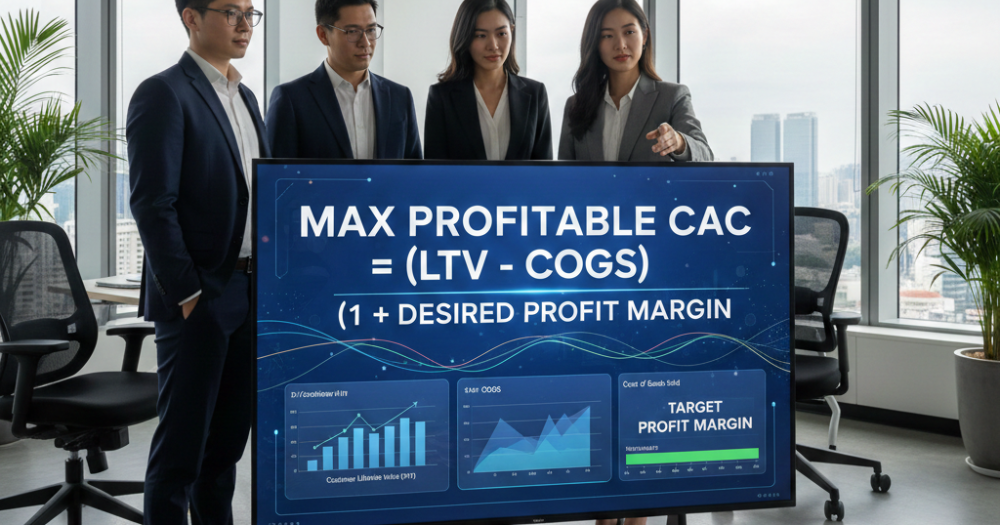
Max Profitable CAC = Average Customer Lifetime Value (LTV) – Total Non-Acquisition Cost (NAC) – Target Profit Margin
Let’s break down the components.
Case Study Snapshot: The S$2,000 CAC Barrier
A B2B SaaS company in Singapore had an Average LTV of S$5,000. Their NAC (hosting, support, sales commissions) was S$1,500. They aimed for a healthy 30% profit margin (S$1,500).
Max Profitable CAC = S$5,000 – S$1,500 – S$1,500 = S$2,000
Their Max Profitable CAC was S$2,000. Any campaign that drives customers below this $2,000 threshold is profitable. This is far more powerful than aiming for a low CPL. For instance, a S$10 CPL campaign with a 1% close rate yields a S$1,000 CAC, which is profitable. However, a S$100 CPL campaign with a 5% close rate yields a S$2,000 CAC, which is still max profitable and often drives higher quality customers. This highlights the dangers of focusing purely on “Max CPL vs Max CAC: The Hidden Growth Killer”.
Connect with our expert team with proven digital marketing strategies that deliver real results.
Connect with us! →Once you know your Max Profitable CAC, the next step is to engineer your campaigns to stay within that budget while maximizing volume. This is where a strategic full-funnel sequencing approach comes in.
Stop trying to guess your exact buyer persona. The algorithms (Meta and Google) are smarter than your 50-year-old lookalike audience. Use a Broad Targeting Strategy for B2B Scale to start. The key is in your creative. An excellent creative lowers your CPM and CTR, making your initial ad spend more efficient. As we discuss in The Max Profitable CAC System: How Creative Lowers Acquisition Costs, a strong hook reduces your effective cost-per-impression.
This is the phase where you nurture potential customers who haven’t converted yet. Instead of stalker-like retargeting with the same ad, use educational content.
Target your warmest leads (those who consumed MOFU content) with your highest-value offer, coupled with strong social proof (local Singapore-based testimonials work best). This final push, thanks to the quality data passed via CAPI, ensures the algorithm efficiently finds the buyer, keeping your final conversion cost within your Max Profitable CAC.







Our team consists of seasoned digital marketers, bringing years of hands-on expertise driving results for SMEs and enterprises throughout the APAC region.
from first click to final sale, across Meta, Google, TikTok, YouTube, and your CRM so you can see what’s working and what’s not.
Your videos, landing pages, ads, and data are aligned under one strategy no more juggling vendors.
Budgets shift based on real-time performance, not monthly meetings.
Leads and traffic you already have get optimized for higher ROI and less waste.
Clear reports, honest feedback, and no jargon, even when results aren’t perfect.
Digital Marketing isn’t just about running ads. It’s about turning data into visible growth.
Many Singaporean SMEs, unfortunately, get trapped in the old paradigm.
Singapore’s digital advertising landscape is competitive, leading to higher Cost Per Click (CPC) in industries like finance, education, and high-tech B2B. A common mistake is panicking over a high S$8-$15 Google Ads CPC and slashing the budget. This is a huge mistake. If your Max Profitable CAC is S$1,500, a high CPC is manageable if you have a robust funnel and a high close rate.
Local Fix: Stop judging campaigns on low CPL or CTR. Start integrating your sales data. If you’re running Google Ads for high-ticket B2B services in Singapore, you need to use Offline Conversions for B2B Google Ads in Singapore. This sends actual close-rate data back to the ad platform, optimizing it for high-quality leads, not just cheap clicks.
Many founders treat NAC as a fixed cost, but it’s not. If your sales team spends 3 hours manually entering leads into the CRM, that salary cost adds to your effective NAC, compressing your profit margin.
Local Fix: Use automation to reduce administrative friction. Implementing a basic automation stack to handle lead scoring and CRM entry can shave off 5-10% of your NAC, which allows you to spend that saved money on a higher Max Profitable CAC campaign, ultimately leading to faster scaling.
Max Profitable CAC for Singapore Founders
The LTV:CAC ratio is a historical measure, ideally $3:1$ or higher. Max Profitable CAC is a **forward-looking budget ceiling** that integrates a required profit margin. For high-ticket services in Singapore, using Max Profitable CAC prevents overspending on campaigns before they even start, securing your cash flow.
Yes, start by using a conservative Average Order Value (AOV) multiplied by the expected number of repeat purchases in the first 12-24 months. This gives you a **proxy LTV** to set an initial, highly-cautious Max Profitable CAC ceiling. As your business matures, update the LTV for greater accuracy.
CAPI improves event match quality and tracking accuracy, especially post-iOS 14. By providing better data to ad platforms, the algorithm optimizes for higher-value conversions, reducing the wasted spend on low-quality leads. This drives down your effective CAC and helps you stay within your **Max Profitable CAC limit**.
Focus on ranking for **"Singapore + [Your Service]"** keywords and securing high-quality local citations. Strong organic visibility reduces your reliance on high-cost Google Ads search campaigns, lowering the blended, total CAC.
Scale immediately and aggressively once you have three consecutive weeks of proven, repeatable campaigns running **below 80% of your Max Profitable CAC**. Use the remaining 20% buffer for testing new channels or creatives, minimizing risk while maintaining profitability.
Treat your **Max Profitable CAC** as a Key Performance Indicator (KPI) within your financial model, not a simple expense. Budget your acquisition spend by multiplying your desired number of new customers by the Max Profitable CAC, allowing you to reliably forecast revenue. This is a core component of a sound Paid Ads Forecasting Framework.
For a globally recognized and reliable framework, **HubSpot offers excellent resources and templates on LTV calculation**, which helps founders accurately determine the revenue component for their Max Profitable CAC formula.
For most venture-backed SaaS businesses, a **CAC Payback Period of 12 months or less** is common. However, profitable scaling in competitive Singapore markets often targets 6-9 months to quickly recycle capital back into ad spend and aggressively outbid slower competitors.
Higher competition for attention and the higher cost of living generally drive up CPMs (Cost Per Mille) and CPCs (Cost Per Click) in metropolitan hubs like Singapore. You must counteract this with superior creative execution, as detailed in The Max Profitable CAC System: How Creative Lowers Acquisition Costs, and focus on high-quality lead events via the **Conversions API**.
No, the content team's salary is part of your **Non-Acquisition Costs (NAC)**, not your CAC. CAC must strictly include only the direct costs of acquiring a customer (ad spend, agency fees, sales commissions on new clients). Including NAC in the CAC calculation will give you a misleadingly low and unsustainable ceiling.
They anchor their spending to the Max Profitable CAC of a competitor or industry benchmark instead of their **own unique unit economics**. Your business's NAC structure and LTV are unique; copying another's CAC ceiling is financially reckless and risks scaling an unprofitable model.
Yes. Often, channels with a **higher upfront CAC** (e.g., highly specific B2B keywords on Google Ads) attract customers with a greater intent, lower churn, and higher long-term value. This is a strategic trade-off where a higher, but still profitable, CAC is worth the long-term gain.
Always respect your **Max Profitable CAC**. Why ROAS Caps Growth is simple: ROAS (Return on Ad Spend) is a great efficiency metric, but it ignores your operational costs (NAC). A high ROAS campaign might look great, but if it doesn't leave your necessary target profit margin, it’s not truly scalable. Max Profitable CAC is the superior metric for sustainable growth.

Your business deserves more. Let ThriveMediaSG help your business Increase Sales through digital marketing.
The Max Profitable CAC (Customer Acquisition Cost) is the single most critical financial threshold for any founder seeking sustainable, aggressive growth. It is the maximum allowable cost to acquire a new customer while ensuring a pre-defined profit margin remains after all operational costs are accounted for. This metric is not a vanity figure; it is the mathematical blueprint for scaling a business without sacrificing cash flow or profitability.
The Max Profitable CAC is defined by the formula: $\text{LTV} – \text{NAC} – \text{Target Profit Margin}$.
This metric matters because it moves advertising from an expense to a calculated investment. Instead of chasing cheap leads, which often have low LTV, a founder uses the Max Profitable CAC to set a bidding ceiling on ad platforms like Meta and Google, ensuring every customer acquired is profitable.
The most effective strategy for aggressive scaling is not lowering CAC, but rather expanding the profitable buffer to allow for a higher Max Profitable CAC.
The NAC Compression Framework
A higher Max Profitable CAC is a strategic advantage when entering highly competitive markets, such as high-intent B2B search queries on Google Ads in Singapore.
Cause–Effect–Outcome: Bidding higher (cause) allows you to capture high-intent customers who convert at a much higher rate and have a lower churn rate (effect). The outcome is a higher LTV from these customers, justifying the higher initial CAC spend and leading to a more valuable, stable customer base.
Post-iOS 14, advertising platform algorithms (like Meta) are only as good as the data they receive. The contrarian insight is that the most impactful way to improve your Max Profitable CAC is not in your budget, but in your tracking quality.
By using server-side tracking via the Conversions API (CAPI) and sending deep data on lead quality (e.g., optimizing for ‘Tour Booked’ instead of low-value ‘Lead’ events, as discussed in CAPI for Singapore’s Preschools), you feed the algorithm precise signals. This causes the algorithm to find customers who fit your ideal LTV profile, leading to a much lower effective CAC over time, even if the Cost Per Click remains high.



Building Brands Since 2001
©2026. ThriveMediaSG. All Rights Reserved.