A spreadsheet-first approach to calculating exactly how much you can pay for a customer.

Imagine this: You’re running successful paid ad campaigns on Meta and Google, and the clicks are flowing. Your Cost Per Lead (CPL) looks great, maybe even too good. Your agency is sending you reports full of high Click-Through Rates (CTR) and low Costs Per Click (CPC). Yet, when you look at the bank account at the end of the quarter, the profit margin feels… thin. You’re busy, but you’re not Max Profitable.
Sound familiar? For too many businesses in Singapore and across Southeast Asia, the path to scaling is paved with metrics that look impressive on a dashboard but don’t translate into genuine profit. This is the core problem: they confuse Cost of Acquisition (CAC) with Profitable Acquisition. A Max Profitable CAC strategy changes that, shifting your focus from simply acquiring a customer to acquiring a customer at a price that guarantees your desired profit margin.
It’s time to retire the rule of thumb that says “LTV should be 3X CAC.” That ratio is a great starting point, but it’s not the final answer. The real blueprint for profitable scaling lies in knowing your Max Profitable CAC to the cent. It’s the highest price you can pay for a new customer and still hit your financial goals.
So, how do we cut through the vanity metrics and build a reliable, profit-first model? It all starts with the simplest, most powerful tool in your arsenal: the spreadsheet.
we shares analysis, strategies on digital marketing everyday.
This service is not intended for persons residing in the E.U. By clicking subscribe, I agree to receive news updates and promotional material from Thrive Media SG
We’re not just going to calculate what your CAC is, we’re going to calculate Max Profitable CAC, which is the maximum amount you can spend on a customer. This requires a level of detail that standard CAC calculations often ignore, specifically the costs beyond your marketing and sales budget and your non-negotiable profit target.
This is a four-step framework that anchors all your advertising efforts, from setting a Target ROAS on Google Ads to defining your bid strategy on Meta (For a deeper dive on feeding ad algorithms for better results, you can read our guide: The Data Decoder: How to Feed Meta and Google Algorithms for Unstoppable ROAS and Client Acquisition).
Your LTV, or Customer Lifetime Value, is the total revenue you expect to receive from a customer over their entire relationship with your business. For a truly profitable calculation, however, we need to focus on Gross Margin LTV, which is LTV minus the Cost of Goods Sold (COGS).
Actionable: Calculate your Average Order Value (AOV) multiplied by your Average Purchase Frequency (APF) multiplied by your Average Customer Lifespan. Then, multiply this revenue by your average Gross Margin Percentage. This Gross Margin LTV is the pool of money from which you must pay your operational costs, acquisition costs, and, crucially, take your profit.

This component includes all operational expenses and overhead costs that are not directly part of the sales and marketing budget (salaries, commissions, media spend). This covers costs like:
Ignoring these costs is the fastest way to get a false positive on your profitability.
This is the non-negotiable step that turns simple CAC into Max Profitable CAC. What percentage of the Gross Margin LTV must be profit for you to consider the acquisition a success? For many scaling businesses in the competitive Southeast Asian market, a Net Profit Margin of 15-25% is essential for reinvestment and stability.
Once you have these three components, the Max Profitable CAC calculation is elegantly simple:
Max Profitable CAC = Gross Margin LTV} – Non-Acquisition Costs} – Target Profit Margin
Example Case: A Singapore E-Commerce business selling recurring subscription boxes.
Metric | Value | Component |
Gross Margin LTV | S$800 | Revenue after COGS |
Non-Acquisition Costs (NAC) | S$200 | Fulfilment, Support, Overhead |
Target Profit Margin (TPM) | S$200 (25% of LTV) | Non-negotiable Profit |
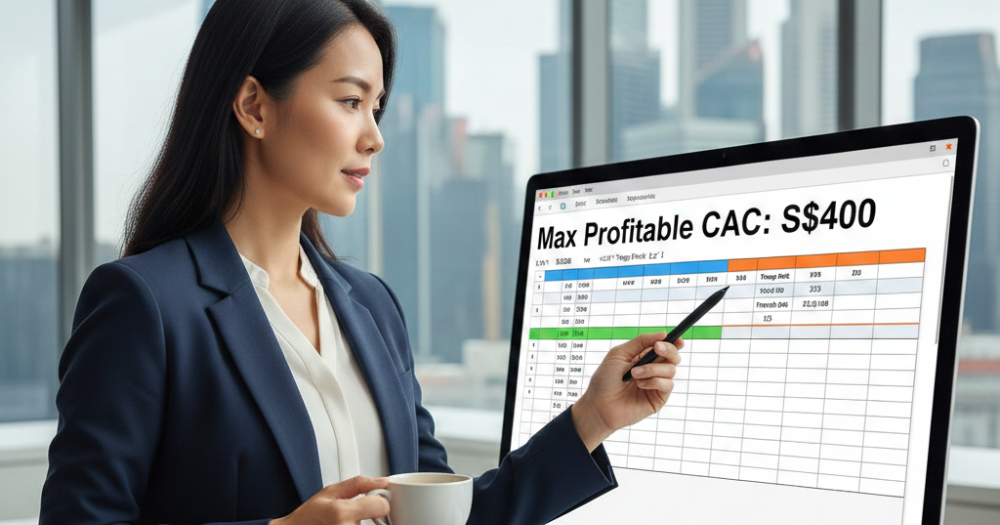
Max Profitable CAC | S$400 | The maximum price to pay for a customer. |
In this scenario, if your current CAC is S$450, you are *losing* S$50 on every new customer. You need to immediately find a way to lower your CAC or increase your LTV/reduce NAC until you hit the S$400 ceiling. This is the absolute, data-driven line in the sand.
Connect with our expert team with proven digital marketing strategies that deliver real results.
Connect with us! →Understanding the formula is one thing, but applying it with real-world context and data adds true depth. In the competitive Singaporean and wider Southeast Asian landscape, cost structures and buying behaviours are unique.
The rise of platforms like Shopee and Lazada, coupled with high delivery expectations, compresses margins and inflates NAC (Non-Acquisition Costs).
Case Study: Boutique Fashion Brand (Singapore)
A small, high-quality fashion retailer in the Orchard area focused on online sales saw their average CAC creep up to S$95. They used the basic LTV:CAC of 3:1 and thought their LTV of S$285 was fine.
Metric | Basic View | Max Profitable View |
Gross Margin LTV | S$285 | S$285 |
NAC (Shipping, returns, customer support, rent allocation) | S$0 (Ignored) | S$80 |
Target Profit Margin (20%) | S$0 (Ignored) | S$57 |
Max Profitable CAC | S$285 | S$148 |
Actual CAC | S$95 | S$95 |
The Actionable Insight here is critical: while their S$95 CAC was well below their S$148 Max Profitable CAC, the initial LTV:CAC ratio of 3:1 gave them a false sense of urgency (they thought they were just “okay”). By knowing their true Max CAC, they had a safe S$53 margin to aggressively test new creative and bidding strategies, allowing for Direct Response vs. Brand campaign testing and a much more confident path to The 20% Scaling Rule.
The education sector in Singapore, including tuition and enrichment centres, operates on high LTV but long sales cycles, which inflates the Wages/Salaries portion of the CAC calculation. Parents are highly discerning, and the decision-making process often involves multiple touchpoints: ad click, brochure download, trial class, and finally, enrolment. This makes accurate tracking and attribution essential (A crucial topic covered in: The $10,000 Lesson I Learned About Tracking the Hard Way
Case Study: Singapore Preschool Enrichment Centre
For this centre, a S$90 Facebook Lead Ad often costs S$150-$200 per lead in certain areas. With a typical 8:1 lead-to-enrolment conversion rate, their CAC is $150 x 8 = S$1,200.
Your business deserves more. Let ThriveMediaSG help your business Increase Sales through digital marketing.

The digital advertising ecosystem in Singapore and across Southeast Asia is uniquely challenging. A high concentration of affluent consumers, intense competition in key verticals like property, finance, and education, and a mobile-first culture mean ad costs (CPC) are generally higher than in less competitive markets. Ignoring these local realities is a common mistake that quickly erodes profitability.
Many Singapore SMEs chase the lowest possible Cost Per Lead (CPL) on platforms like Meta or LinkedIn. However, a cheap lead that requires 20 hours of sales effort to qualify and close is often more expensive than a high-CPL lead that is pre-qualified.
In competitive industries like wealth management or specialised education in Singapore, the Cost Per Click (CPC) on Google Search can easily exceed S$10-$20. This can scare off business owners focused purely on low initial cost.
However, if your calculated Max Profitable CAC is S$1,500, a S$15 CPC with a 2% website conversion rate and a 50% lead-to-customer close rate is still deeply profitable.
For any business with a physical presence in Singapore (retail, dental clinics, enrichment centres), local SEO signals are critical for reducing reliance on high-CPC paid ads. Consumers frequently search for ‘best dentist near Tiong Bahru’ or ‘preschool enrichment centre Yishun.’







Our team consists of seasoned digital marketers, bringing years of hands-on expertise driving results for SMEs and enterprises throughout the APAC region.
from first click to final sale—across Meta, Google, TikTok, YouTube, and your CRM so you can see what’s working and what’s not.
Your videos, landing pages, ads, and data are aligned under one strategy no more juggling vendors.
Budgets shift based on real-time performance, not monthly meetings.
Leads and traffic you already have get optimized for higher ROI and less waste.
Clear reports, honest feedback, and no jargon—even when results aren’t perfect.
Digital Marketing isn’t just about running ads—it’s about turning data into visible growth.
Understanding the formula is necessary, but avoiding the common pitfalls is what separates the consistently profitable from the ones that hit a wall. Here are the most frequently asked questions about the calculation errors found in Singaporean and regional businesses:
Mistake/Trap | Description and Outcome | Actionable Fix |
Ignoring Salaries/Overhead | Only counting media spend and agency fees. This leads to a dangerously low, false CAC, resulting in underpricing products or overselling advertising success. | Include a reasonable, pro-rata allocation of all team salaries, software costs (CRM, analytics), and a portion of rent/utilities dedicated to sales and marketing activities. |
Mixing New vs. Existing Customers | Including costs for retention campaigns, upsells, or loyalty programs in the CAC calculation. CAC is only for acquiring new customers. | Ring-fence all retention costs and calculate them separately as Customer Retention Cost (CRC). Focus the CAC formula only on expenses tied to first-purchase acquisition. |
Inconsistent Time Windows | Calculating sales/customers over a 30-day period but including 60 days of ad spend, or failing to account for a long B2B sales cycle. | Use a cohort analysis and ensure the total acquisition costs are aligned with the customers who converted from that specific period’s spend, often looking at a 60- or 90-day lag. |
Confusing CAC with CPA/CPL | Assuming Cost Per Lead (CPL) or Cost Per Action (CPA) on the ad platform is your final CAC. These are upstream metrics. | Max Profitable CAC is the final, fully loaded cost after conversion rates, sales team time, and profit target are factored in. Never equate a platform metric with a financial metric. |

The true power of knowing your Max Profitable CAC is that it provides a quantitative framework for strategic growth and investment decisions. It’s no longer about whether you can afford to run Facebook or Google Ads, but how much you must invest to hit your growth targets profitably.
Acquirers and investors, particularly in the private equity space, don’t just look at revenue. They scrutinise the sustainability and efficiency of your growth engine. A low, clearly defined, and consistently tracked Max Profitable CAC is a signal of a mature, systems-driven business, not one reliant on heroic marketing efforts.
According to a report from HubSpot, companies with an LTV:CAC ratio greater than 4:1 consistently command higher valuations because the unit economics are proven to be highly sustainable. When you can prove that your Max Profitable CAC allows for a significant margin after all operating costs, your business becomes an attractive, scalable investment. This is the ultimate payoff for adopting a Direct Response vs. Brand: The Data-Driven Blueprint for 3X Profitable Scaling mindset.
We always stress that in the complex world of paid media, only a few metrics truly matter. Your Max Profitable CAC should be the central metric that dictates all others.
(For more on this, check out our piece on The 3 Metrics That Matter).

Your business deserves more. Let ThriveMediaSG help your business Increase Sales through digital marketing.
Max Profitable CAC is the strategic ceiling for your customer acquisition budget. It moves beyond the common practice of dividing total ad spend by new customers. It includes a mandatory deduction for all operational expenses and a pre-defined profit margin.
The metric matters because it prevents unprofitable scaling. In the post-iOS14 world, ad platforms like Meta and Google struggle with precise attribution, leading to inaccurate Return on Ad Spend (ROAS) reporting. Anchoring your campaigns to a fixed, financially validated Max Profitable CAC ensures that even if platform tracking is flawed, your core unit economics remain profitable.
The calculation for the Max Profitable CAC is derived from three core components. We call this the Profitable Growth Framework:
This is the total revenue a customer generates minus the Cost of Goods Sold (COGS). It is the pool of funds available for all operational costs, acquisition, and profit.
These are operational costs allocated to the customer that are not part of sales or marketing spend. For a Singapore-based SaaS business, this could be Customer Success Manager salary allocation, server hosting fees, and rent.
This is the profit goal the business must achieve on every customer. It is expressed as a dollar amount or a percentage of GMLTV.
The relationship is expressed as: Max Profitable CAC = GMLTV – NAC – TPM.
Cause-Effect-Outcome: When a business uses Max Profitable CAC to set its Target ROAS on platforms, the effect is that the ad campaigns are optimized for financial outcome rather than platform vanity metrics, resulting in sustainable growth.
Max Profitable CAC is the primary input for two critical business decisions:
In Google Ads, for instance, your Target CPA should never exceed your Max Profitable CAC, adjusted for the sales team’s closing rate. An opinionated insight here is that companies should be willing to accept a higher platform CPA for campaigns (e.g., branded search) that deliver a higher-intent lead, provided the final Max Profitable CAC remains untouched. The focus should be on efficiency of conversion, not cost of click.
If the current CAC is consistently higher than the calculated Max Profitable CAC, the solution is not always to cut ad spend. The correct step is often to increase the GMLTV component by raising prices or creating higher-value bundles. The Max Profitable CAC acts as a market signal to the product team.
A precise Max Profitable CAC calculation requires accurate data feedback, which is best achieved by integrating your CRM (e.g., HubSpot, Salesforce) with ad platforms using the Conversions API (CAPI) for Meta or Offline Conversion Import for Google. This bypasses client-side tracking limitations and ensures the platforms are optimizing toward the most profitable customers, not just the cheapest clicks. This advanced tracking is critical for accurate financial reporting in 2025 and beyond.
The journey to profitable scaling in Singapore requires precision. Your Max Profitable CAC is your most powerful lever.
Your Max Profitable CAC isn’t just a number, it’s a strategic mandate that ensures every dollar spent on customer acquisition returns multiple dollars in guaranteed profit. This is the only way to achieve sustainable, aggressive growth in the competitive Singaporean market.
Frequently Asked Questions (FAQ) about Max Profitable CAC in Singapore
The Max Profitable CAC is the highest cost a Singapore business can pay to acquire a new customer while still achieving its desired profit margin. It is not a fixed number, but a calculated ceiling. It is found by taking the customer's Gross Margin LTV and subtracting all Non-Acquisition Costs and the Target Profit.
While the 3:1 ratio is a solid benchmark, it doesn't account for specific Non-Acquisition Costs and the non-negotiable Target Profit Margin unique to the competitive Singapore market. Calculating the Max Profitable CAC ensures your ads budget is based on guaranteed profitability, not just a general industry rule.
High Cost Per Click (CPC) on platforms like Google Ads for finance or property in Singapore necessitates higher quality traffic to maintain a profitable funnel. If your conversion rates are strong, a high CPC can still lead to a low final Max Profitable CAC because the LTV outweighs the cost. Focus on improving ad relevance and landing page experience.
For B2B in Singapore with long sales cycles, calculate the Gross Margin LTV based on the average customer contract value over the expected relationship lifespan, after deducting COGS. You must then accurately map this LTV to the Max Profitable CAC using Offline Conversions tracking to truly close the data loop.
Non-Acquisition Costs (NAC) include all non-media spend operational expenses necessary to service a customer. In Singapore, this includes allocated portions of high-rent overhead, customer service staff salaries, fulfilment costs, and software fees (CRM, accounting) that exist post-acquisition. Ignoring NAC will dangerously inflate your calculated Max Profitable CAC.
Costs from formal, paid referral programs should generally be tracked separately, as they represent a highly efficient, high-LTV acquisition channel. However, if referral bonuses are a consistent part of your first-purchase acquisition strategy, they must be included in the total CAC to avoid underestimating the Max Profitable CAC ceiling.
A Singapore SME should recalculate its Max Profitable CAC at least quarterly, or immediately following any significant change in pricing, product gross margin, or operational costs (e.g., increased rent or higher salary costs). The goal is to always ensure your ad bidding is anchored to your most current financial reality.
Increasing AOV directly boosts your Gross Margin LTV, which is the first component in the Max Profitable CAC formula. A higher LTV effectively raises your Max Profitable CAC ceiling, giving you more budget flexibility to bid more aggressively on high-quality traffic on platforms like Meta and Google, which aids profitable scaling.
First, calculate your Max Profitable CAC. Then, use the simple formula: Target ROAS = Gross Revenue / Max Profitable CAC. For example, if your average revenue is S$800 and your Max Profitable CAC is S$400, your minimum Target ROAS is 2.0. You should set your platform Target ROAS higher (e.g., 2.5) to build a safety buffer.
A long sales cycle increases the salary and overhead costs associated with sales follow-up and nurturing (increasing NAC). Therefore, while LTV is high, the initial CAC must be managed. Automation for lead nurturing can reduce these Non-Acquisition Costs, allowing the centre to maintain a higher, more flexible Max Profitable CAC.



Building Brands Since 2001
©2026. ThriveMediaSG. All Rights Reserved.