we shares analysis, strategies on digital marketing everyday.
This service is not intended for persons residing in the E.U. By clicking subscribe, I agree to receive news updates and promotional material from Thrive Media SG
In the post-iOS 14, privacy-centric world, the algorithm’s intelligence hinges on two things: signal fidelity and signal density.
How does creative feed the algorithm? Every interaction with your ad—the initial view, the click, the watch time, the comment, the share—is a creative signal. A compelling ad that stops the scroll and generates high-intent clicks is teaching the algorithm two things instantly: “This creative is highly engaging” and “These types of users find this content relevant.”
To maximize this process, you need a structured creative testing framework.
The biggest trap in creative testing is testing surface-level elements like button colors or a slightly different headline. The algorithm needs fundamental, high-contrast signals.
Actionable: Adopt a Concept-First Testing approach. Test three distinct, high-contrast angles (the core narrative or value proposition), not minor design tweaks.
Concept Angle | Creative Execution | Signal to the Algorithm |
|---|---|---|
Problem/Agitation | Founder ranting about a common industry flaw. | Highly controversial, generates debate, high comments/shares. |
User Transformation | Before/After format, or a quick, relatable story of success. | High click-through rate (CTR), strong indicator of buying intent. |
Mechanism/How-To | Quick tutorial breaking down a unique product feature. | High average watch time, signals high informational intent. |
By testing these distinct angles, you provide the algorithm with clean, separate datasets. It quickly learns that users who respond to a “Problem/Agitation” ad are distinct from users who respond to a “User Transformation” ad, even if they share the same broad demographic. This significantly speeds up the learning phase.
Connect with our expert team with proven digital marketing strategies that deliver real results.
Connect with us! →Confusing the machine learning model is the most expensive mistake you can make. This typically happens in two major ways:
Many businesses in Singapore, especially in the B2B or high-ticket services space, optimize their campaigns for low-value events like “Page View” or “Lead” when a qualified action like “Tour Booked” or “High-Intent Demo Request” is available. This is a crucial area we addressed in CAPI for Singapore’s Preschools: Optimizing for ‘Tour Booked’ Instead of Low-Value ‘Lead’ Events.
If you feed the algorithm thousands of “leads” that are just spam or low-quality enquiries, the algorithm will become world-class at finding people who fill out forms with fake data. You must feed the algorithm the most down-funnel, profitable conversion signal possible. For B2B, this often means sending back Offline Conversions—closed deals or sales-qualified leads—which provides the ultimate clean, high-fidelity signal.
Imagine two creatives in the same ad set: Creative A (Professional, corporate, B2B-style) and Creative B (UGC, informal, direct-to-consumer style).
The algorithm may struggle to find a single, unified audience that responds equally to both. It might push spend to Creative B for a day, see a high CTR but low conversion, then switch to Creative A, see a low CTR but high conversion value, and then get stuck in an endless loop of unstable delivery. Isolate your tests. If you’re testing an informal, UGC style, group all your UGC variants together. If you’re testing high-production value, group those. This gives the algorithm a clean runway to learn which type of user responds to which type of creative, dramatically increasing performance stability.
Many local businesses in Singapore, despite the high cost of acquisition, continue to make critical creative mistakes.
To survive in the competitive Singapore digital marketing space, you must prioritize creative velocity.







Our team consists of seasoned digital marketers, bringing years of hands-on expertise driving results for SMEs and enterprises throughout the APAC region.
from first click to final sale, across Meta, Google, TikTok, YouTube, and your CRM so you can see what’s working and what’s not.
Your videos, landing pages, ads, and data are aligned under one strategy no more juggling vendors.
Budgets shift based on real-time performance, not monthly meetings.
Leads and traffic you already have get optimized for higher ROI and less waste.
Clear reports, honest feedback, and no jargon, even when results aren’t perfect.
Digital Marketing isn’t just about running ads. It’s about turning data into visible growth.
Creative Signal Density & Algorithm Performance
Creative acts as the primary audience filter. Instead of relying on restricted interest groups, a highly specific creative attracts the right person and repels the wrong one. This sends a clean, high-intent creative signal back to the algorithm, allowing it to rapidly learn and find more lookalikes, crucial for lowering your competitive local ad costs in Singapore's market. [Image illustrating creative as the primary audience filter and targeting mechanism]
This usually results from Signal Dilution, where your budget is spread too thinly across too many ad sets, preventing any single one from gathering enough data. The fix is to consolidate your budget into fewer, larger ad sets with broad targeting to improve signal density and speed up the algorithm’s learning.
The most common error is testing for variety, not for a core hypothesis, and failing to use sufficient budget for signal density. This leads to confusing signals and wasted spend. Focus on high-contrast tests and ensure your conversion tracking via Conversions API is clean to ensure high signal fidelity.
High CPCs in competitive sectors are common due to high advertiser density. The solution is not always higher budget, but better creative signals. A low-engagement creative lowers your Ad Quality Score, which directly increases your cost. Improving the scroll-stop rate and CTR with fresh creative will lower your CPC.
Creative fatigue occurs when the same ad is shown too often, leading to a drop in engagement and an increase in CPM. This sends a negative creative signal to the algorithm, causing it to slow down or raise delivery costs. A regular, high-velocity testing loop with fresh creative signals is the fix.
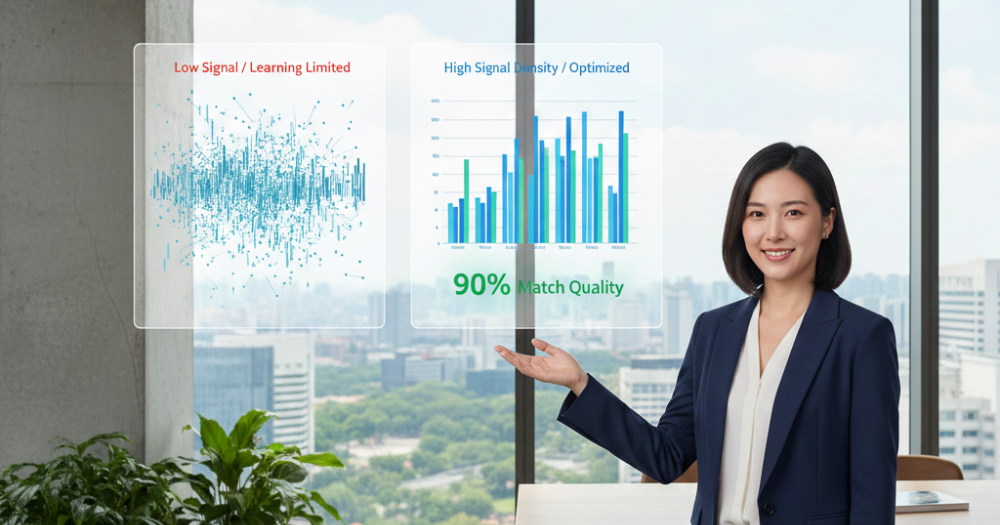
The '50 Conversion Rule' suggests that an ad set needs approximately 50 desired conversion events per week to achieve stable performance and fully exit the 'Learning Limited' phase. This is the minimum signal density required for the machine learning model to effectively predict future high-value conversions. [Image illustrating the 50 Conversion Rule and the transition from Learning Limited to Active/Stable Performance]
Signal Density is the volume and consistency of conversion data. A high density, typically requiring around 50 conversions per week per ad set, allows the machine learning model to exit the ‘Learning Limited’ phase. This ensures your budget is spent efficiently, which is vital given the high CPC industries in Singapore, such as finance and education.
Yes, you should, but use a structured creative testing approach. Group creatives with the same core angle or concept together. Testing high-contrast ideas (e.g., UGC vs. polished studio ad) side-by-side provides clear and differentiated creative signals, which speeds up the platform's ability to match the right ad to the right user.
Signal Fidelity is about data quality. Implement server-side tracking (Meta CAPI or Google Enhanced Conversions) to bypass ad blockers. Furthermore, send back the most down-funnel event possible, like ‘Purchase’ or 'Sales Qualified Lead,' instead of just ‘Landing Page View’ or a low-value 'Lead' event.
Always optimize for a confirmed, high-value Conversion event. Optimizing for just clicks provides a weak signal. The best creative will generate a high-intent click that leads to a conversion, which gives the algorithm the clearest, most valuable creative signal to find more paying customers.
Short-form video, such as Instagram Reels and YouTube Shorts, is currently the dominant format. This is because video allows for more high-contrast, platform-native creative signals (e.g., watch time, swipe-up, audio use) compared to static images, which the algorithm can use for faster optimization in the mobile-first Southeast Asia region.
Yes, because your niche creative is your filter. On platforms with high signal density, the algorithm can take a high-contrast creative and find your niche audience faster within a broad pool than you can with limited, interest-based targeting. The creative does the heavy lifting, not the audience settings.

Your business deserves more. Let ThriveMediaSG help your business Increase Sales through digital marketing.
The modern success of digital advertising on platforms like Meta and Google is driven not by precise audience targeting, but by high-quality, consistent Creative Signals. This means the ad creative itself must function as the primary targeting filter, teaching the algorithm who to show the ad to and what valuable action to optimize for.
The core principle is simple: Better creative means better data, and better data means faster optimization.
A Creative Signal is any measurable user interaction with an ad creative that provides data back to the ad platform’s machine learning model. This includes micro-interactions like:
Post-Click Conversion: The ultimate signal that the creative attracted a buyer (high business value).
Creative signals matter more than audience targeting because of the post-iOS 14 data environment and the rise of platform-native automation (e.g., Advantage+ Shopping, Performance Max).
Outcome: A broad audience ad with a hyper-specific, high-performing creative can quickly self-select the ideal buyer better than a restrictive, outdated interest-based target.
The Signal Density Framework is a mental model for maximizing the learning speed of the algorithm.
A common mistake is aiming for creatives that are universally ‘liked’. The contrarian insight is that the most effective creative is often the most divisive, not the most agreeable.



Building Brands Since 2001
©2026. ThriveMediaSG. All Rights Reserved.