we shares analysis, strategies on digital marketing everyday.
This service is not intended for persons residing in the E.U. By clicking subscribe, I agree to receive news updates and promotional material from Thrive Media SG
Let’s face it, Customer Acquisition Cost (CAC) in Singapore is getting brutal. Media costs on platforms like Meta and Google are consistently above global benchmarks, with Facebook CPCs sometimes peaking over $2.40, according to 2025 data, especially during competitive Q4 periods. If you’re running a B2B service or SaaS business in the Lion City, simply throwing more budget at the problem is a fast track to burning cash.
But what if you could dramatically lower your effective CAC by 40% to 50% without touching your ad budget? It’s not a pipe dream, it’s a math problem we solve by focusing on conversion and data accuracy, which is the cornerstone of achieving your Max Profitable CAC.
The conventional wisdom says to lower CAC, you must lower your Cost Per Click (CPC) or Cost Per Lead (CPL). The advanced playbook shifts focus to your post-click experience and data fidelity. This approach combines Conversion Rate Optimization (CRO), advanced tracking, and multi-touch attribution to turn more clicks into customers, making every dollar of ad spend work harder.
In a high-cost market like Singapore, a sloppy landing page is a luxury you cannot afford. Every visitor from a paid ad channel is an expensive commodity. Your goal must be a frictionless path to conversion.
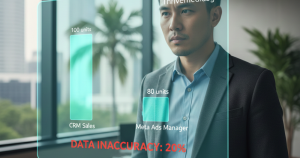
Even the best campaign will fail if your ad platform’s algorithm is feeding on junk data. Post-iOS 14, accurately tracking conversions, especially high-value ones, is a competitive advantage. This is where advanced tracking techniques become non-negotiable for anyone serious about Advanced CAC Optimization Techniques.
Optimised CAC = Ad Spend / New Customers Acquired x (1+CRO UpLift)
In a real-world Singapore case study for a B2B SaaS, an initial CAC of $500 dropped to $300 (a 40% reduction) within three months by combining a 25% CRO lift on the landing page with accurate back-end CAPI reporting of MQLs instead of all leads.
Connect with our expert team with proven digital marketing strategies that deliver real results.
Connect with us! →Many Singaporean SMEs and even larger corporations in Southeast Asia are still making fundamental mistakes that inflate their customer acquisition cost. These traps are particularly costly in an environment of rising ad spend and fierce competition from global players.
The Problem: The most frequent and costly mistake is not validating their conversion tracking setup. They rely on the default Facebook Pixel or Google Tag without checking Why is My Facebook Ad Tracking Inaccurate? This is compounded by a fear of implementing server-side solutions due to perceived complexity.
The Fix: Immediately audit your tracking. Implement the Meta Conversions API (CAPI) and Google Tag Manager Server-Side to send hashed PII data. This ensures a high Event Match Quality (aim for 90%+) and gives the ad platform the clean, deep data it needs to find more profitable customers, which you can learn about in Achieving 90%+ Event Match Quality: The Advanced PII Parameters You Need to Send via CAPI.
The Problem: Many businesses, especially in high CPC industries like education, finance, and specialized B2B services, still optimize their ad campaigns for low-value events like ‘Lead’ or ‘Download’. Given the high cost of media (e.g., Google Ads for B2B keywords in Singapore can exceed S$15 per click), this optimization is too blunt and attracts low-intent prospects.
The Fix: Shift your optimization event to a mid-funnel, high-intent action. For a Singaporean enrichment centre, this is “Tour Booked” instead of “Enquiry Form Submitted.” For SaaS, it’s a “Free Trial Started” or “Demo Completed.” This immediately forces the algorithm to focus its spend on the most valuable portion of your audience. This strategy is also a pillar of effective Creative-Led Growth, ensuring your best-performing ads reach the right people.
The Problem: Most Singapore SMEs still rely on last-click attribution, which is entirely broken post-privacy changes. This miscredits the last ad a user saw before converting, leading to over-investment in bottom-of-funnel retargeting and under-investment in brand-building top-of-funnel campaigns.
The Fix: Adopt a multi-touch attribution model (e.g., Position-Based or Data-Driven). This gives credit to the initial ad that introduced the user and the middle ads that nurtured them. This holistic view is crucial for understanding the true Marginal CAC & Budgeting Meta Ads in Singapore, which leads to better budget allocation and a lower blended acquisition cost overall.







Our team consists of seasoned digital marketers, bringing years of hands-on expertise driving results for SMEs and enterprises throughout the APAC region.
from first click to final sale, across Meta, Google, TikTok, YouTube, and your CRM so you can see what’s working and what’s not.
Your videos, landing pages, ads, and data are aligned under one strategy no more juggling vendors.
Budgets shift based on real-time performance, not monthly meetings.
Leads and traffic you already have get optimized for higher ROI and less waste.
Clear reports, honest feedback, and no jargon, even when results aren’t perfect.
Digital Marketing isn’t just about running ads. It’s about turning data into visible growth.
Max Profitable CAC Application and Tracking
CAC is a simple cost metric, but **Max Profitable CAC** defines the highest cost you can pay to acquire a customer while still achieving your target profit margin and CAC Payback Period. Given Singapore's high ad costs, this ratio-based metric prevents you from accidentally scaling unprofitable campaigns.
New privacy rules, including global shifts like iOS 14, mandate a reliance on first-party data. This has severely damaged the accuracy of the old Facebook Pixel and Google Tag, driving up your reported customer acquisition cost. Implementing **server-side tracking (CAPI, GTM Server-Side)** is now essential to maintain data quality and optimize campaigns effectively.
High CPCs are due to intense competition and high customer lifetime value (LTV) in these specific Singaporean industries. To lower your effective CAC, you must focus on improving your **Quality Score** through highly relevant ads and landing pages, and by using Offline Conversions for B2B Google Ads in Singapore to bid on actual sales, not just clicks.
Always start with **CRO (Conversion Rate Optimization)**. Increasing your conversion rate from 2% to 4% effectively halves your customer acquisition cost without spending an extra dollar. Scaling volume before optimizing your conversion rate simply scales your inefficiency, quickly escalating your marginal CAC.
The most common cause is incorrect event naming or mismatched parameters between the browser pixel and the server-side event. Check your event setup tool to ensure event names, **event IDs**, and critical PII data parameters (like email and phone number) are correctly passed and hashed. Refer to our CAPI Deduplication Failed guide for a detailed troubleshooting process.
The core formula is $\text{Max Profitable CAC} \leq \frac{\text{LTV}}{\text{Ratio}}$, where the ideal LTV:CAC ratio is generally $\geq 3:1$. For SaaS in Singapore, you must also factor in a target payback period (e.g., 6–12 months) due to cash flow concerns, making the formula: $$\text{Max Profitable CAC} = \text{MRR} \times \text{Gross Margin} \times \text{Payback Period}$$.

Your business deserves more. Let ThriveMediaSG help your business Increase Sales through digital marketing.
Advanced Customer Acquisition Cost (CAC) optimization is the strategic process of enhancing your post-click conversion rate and data accuracy to make every dollar of ad spend more efficient. It is why you can reduce your effective CAC by as much as 50% without increasing your budget. This matters because simply running more ads in high-cost regions like Singapore is an unsustainable growth model. This playbook is for founders and marketing operators in B2B and SaaS who are feeling the squeeze of rising media costs and inaccurate performance data.
Advanced CAC optimization moves beyond simple ad platform bidding and focuses on the high-leverage points after a user clicks your ad. The primary levers are Conversion Rate Optimization (CRO) and Conversion Value Optimization (CVO). It is a process that seeks to maximize the percentage of ad-driven traffic that converts into paying customers, thereby decreasing the denominator of the CAC calculation.
The shift to server-side tracking, specifically the use of the Meta Conversions API (CAPI), is the most critical modern technique. The cause is third-party data deprecation (e.g., iOS 14, cookie phase-out). The effect is a loss of up to 40% of conversion data accuracy in the ad platforms. The outcome of adopting CAPI is a clean data stream that feeds the platform’s algorithm a richer, more accurate signal, enabling it to automatically bid for higher-quality, more profitable customers, thus lowering the true customer acquisition cost.
The optimization process can be broken down into a simple, non-linear framework:
Optimize for Value: Shift your primary ad optimization event from a low-intent action (like ‘Click’) to a high-intent, mid-funnel event (like ‘Demo Booked’). This is the Max Profitable CAC principle in practice.
A small, consistent improvement at each stage of the funnel leads to a massive overall reduction in CAC. This is the Conversion Multiplier mental model. For instance, a B2B sales cycle with four stages: Click $\rightarrow$ Lead $\rightarrow$ Qualified $\rightarrow$ Customer.
If you improve the conversion rate at each stage by just 10% (e.g., Lead-to-Qualified, Qualified-to-Customer), the compound effect is a 46.4% increase in total customers for the same initial ad spend. Cause: Incremental CRO at every stage. Effect: Increased final customer volume. Outcome: A dramatically reduced effective CAC. This insight is non-obvious: The greatest CAC reduction does not come from lowering CPC, but from compounding micro-optimizations across the entire funnel.
You must employ multi-touch attribution (e.g., first-touch + last-touch) immediately if your sales cycle is longer than 30 days. Last-click attribution will miscredit your retargeting campaigns and convince you to starve your essential top-of-funnel (TOFU) awareness campaigns. This leads to an unsustainable growth ceiling. Attribution modeling, therefore, is an advanced CAC technique that ensures budget is allocated to the channels that begin the customer journey, securing future growth.



Building Brands Since 2001
©2026. ThriveMediaSG. All Rights Reserved.