we shares analysis, strategies on digital marketing everyday.
This service is not intended for persons residing in the E.U. By clicking subscribe, I agree to receive news updates and promotional material from Thrive Media SG
The core challenge in paid media is the diminishing returns of scale. When you increase your daily budget, you inevitably push into less-qualified audiences, causing your CAC to rise. This is why a $100/day campaign with a S$20 CAC rarely scales to a $10,000/day campaign with the same performance. To combat this, we must shift from a ‘fire and forget’ budget mentality to an incremental, data-anchored approach.
The cornerstone of this safe scaling strategy is a deep understanding of your Max Profitable CAC. This is the highest CAC you can afford before losing money, factoring in your business’s operating costs and desired profit margin. Everything in your scaling effort must be measured against this ceiling.
Aggressive budget increases (e.g., doubling your budget overnight) shock the ad platform’s algorithm, forcing it to exit the ‘learning phase’ and hunt for conversions in less-optimal pockets of the audience. This almost always leads to a higher CAC.
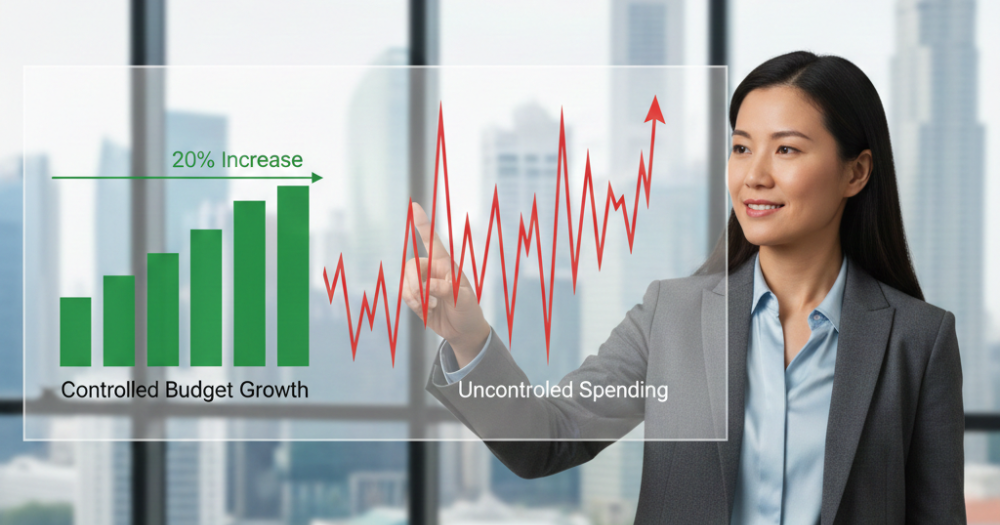
The Rule: Never increase an active campaign’s budget by more than 20% every 48 hours.
This slow, methodical increase, which we call the 20% Scaling Rule, allows the algorithm to re-optimize and stabilize within its current performance band. For a Singapore-based B2B service targeting a S$500,000 annual contract, even a small 5% spike in CAC can wipe out the profit margin from several deals. By sticking to the 20% rule, you give the system time to ‘digest’ the new spend while maintaining your desired performance.
Platform | Current Daily Spend | Max Daily Increase (20%) | Next Target Spend |
|---|---|---|---|
Meta Ads | S$500 | S$100 | S$600 |
Google Ads | S$2,000 | S$400 | S$2,400 |
Instead of a single, massive budget, use a ‘Batch Budgeting’ approach. Allocate your total monthly ad spend into smaller, segmented campaigns or ad sets, each with a specific goal and a fixed, slightly lower Max Profitable CAC target.
This strategy isolates performance. If Batch 2’s CAC spikes to S$150, you pause only Batch 2, protecting the performance of the profitable Batch 1 and 3, and preserving cash flow.
The most advanced concept is Marginal CAC. This is the cost of acquiring the next customer, not the average cost of all customers. As you scale, the Marginal CAC is always higher than your Average CAC.
Actionable: Track your daily CAC and your change in CAC. If your daily CAC is accelerating faster than your 20% budget increase, pause and optimize creatives or targeting before spending more.
Connect with our expert team with proven digital marketing strategies that deliver real results.
Connect with us! →Many SMEs in Singapore, even those with high-ticket offerings, fall into common cash flow traps because they don’t treat ad spend as an investment, but as an expense.
Post-iOS 14, accurate ad tracking has become non-negotiable. We still see many Singapore businesses relying solely on the shaky Meta Pixel. This under-reports conversions, causing them to unnecessarily cut profitable campaigns.
The Fix: Implement Server-Side Tracking via the Conversions API (CAPI). This is crucial for high-ticket services where a single missed conversion means a six-figure revenue loss. You can learn more about how to achieve 90%+ Event Match Quality by sending advanced PII parameters, which significantly improves the accuracy of your ad platform data and allows for safer scaling.
In high-cost industries like education and finance prevalent in Singapore, a high initial CAC is acceptable only if the CAC Payback Period is short enough for your cash flow (e.g., less than 90 days). Failing to calculate the CAC Payback Period: How Long is Too Long? is a common mistake. If it takes 18 months to recoup your S$5,000 acquisition cost, your cash flow is dead in the water, even if you are technically profitable on paper.
Chasing low Cost Per Lead (CPL) instead of a profitable CAC is a huge mistake, especially for B2B services. Low-quality leads from a cheap CPL campaign still require the same sales effort but have a significantly lower conversion rate, ultimately driving your true, end-of-funnel CAC higher. Always focus on your ultimate conversion metric, not the middle-of-the-funnel metric (Max CPL vs Max CAC: The Hidden Growth Killer).







Our team consists of seasoned digital marketers, bringing years of hands-on expertise driving results for SMEs and enterprises throughout the APAC region.
from first click to final sale, across Meta, Google, TikTok, YouTube, and your CRM so you can see what’s working and what’s not.
Your videos, landing pages, ads, and data are aligned under one strategy no more juggling vendors.
Budgets shift based on real-time performance, not monthly meetings.
Leads and traffic you already have get optimized for higher ROI and less waste.
Clear reports, honest feedback, and no jargon, even when results aren’t perfect.
Digital Marketing isn’t just about running ads. It’s about turning data into visible growth.
Safe Ad Scaling, Cash Flow, and Max Profitable CAC
The **Max Profitable CAC** is the highest cost you can pay to acquire a customer while remaining profitable after all operating expenses. For high-rent Singapore locations or high-value services, calculating this metric is essential, as it acts as the non-negotiable ceiling for all your Meta and Google scaling ads.
Your CAC increases because scaling forces ad platforms to target less-qualified segments of your audience, driving up the cost of the auction. This highlights the importance of using **marginal CAC analysis** to decide if the next dollar spent is still profitable, ensuring you avoid killing cash flow. [Image comparing Marginal CAC (Cost of Next Customer) vs. Average CAC (Total Cost/Total Customers)]
Marginal CAC is the cost of acquiring the next customer. It is a key metric for scaling ads as it helps you identify the exact point where increasing your budget by S$1 will cause the cost of that additional customer to exceed your Max Profitable CAC, which is the ultimate goal of the 20% Scaling Rule.
The most common mistake is scaling based on a good average ROAS instead of the Marginal CAC and neglecting the CAC Payback Period. This often leads to overspending before cash is recouped, causing a temporary, but serious, cash flow deficit.
For your Tampines tuition center, use **Batch Budgeting** by segmenting your spend: Batch A for hyper-local retargeting (low CAC), Batch B for new parental audiences (moderate CAC), and Batch C for broad geographic reach (higher, exploratory Marginal CAC). Only scale up the batches that stay within their respective Max Profitable CAC limits.
Before you begin scaling ads, you must track: **Average CAC, Max Profitable CAC, LTV, and your CAC Payback Period**. Focusing on these metrics prevents you from making decisions that look good on a ROAS report but ruin your cash flow.
For Performance Max, you should increase the target Return on Ad Spend (tROAS) bid down by **20%** (to spend more) or increase the campaign budget up by **20%** every **48 hours**. This incremental adjustment prevents the algorithm from re-learning too quickly, which protects your cash flow during safe ad scaling. [Image illustrating the 20% Scaling Rule/Incremental Budget Increase Over Time]
Yes, **Broad Targeting Strategy** is safe and often more effective post-iOS 14, but only when combined with highly engaging creatives and a solid data feed, such as the Conversions API. The broad audience provides the volume, and the creative filter provides the quality needed for sustainable safe ad scaling. [Image illustrating the Broad Targeting Strategy Funnel where creative acts as the filter]
You should aim to increase your budget by no more than **20% every 48 hours**. This cadence, known as the **20% Scaling Rule**, gives the ad platform's algorithm enough time to adjust to the new spend without destabilizing your performance, which is vital for preserving cash flow.
Absolutely. Accurate tracking, especially via **CAPI**, sends reliable, high-quality data back to Meta and Google, allowing their algorithms to optimize more effectively. This results in a more stable and lower Max Profitable CAC at scale, directly supporting safe ad scaling.
Your **Customer Lifetime Value (LTV)** is the foundation of your Max Profitable CAC. A higher LTV allows for a higher CAC, which gives you more competitive bidding power in the ad auction, enabling more aggressive but still safe scaling ads. You must know your **LTV-to-CAC ratio**.
Google Search Ads scaling is often limited by search volume, unlike Meta's broader inventory. You can scale Google Ads rapidly until you hit the volume ceiling, but the **20% Scaling Rule** still applies to prevent sudden bidding wars that spike the Marginal CAC against your Max Profitable CAC.

Your business deserves more. Let ThriveMediaSG help your business Increase Sales through digital marketing.
Scaling Meta and Google Ads is an investment, not a simple expense. The process of increasing ad spend often leads to a disproportionate spike in Customer Acquisition Cost (CAC), ultimately destroying cash flow for rapidly growing businesses in Singapore. The solution is the Marginal CAC Framework.
The Marginal CAC Framework is a data-driven process used to determine the profitability of the next dollar spent on advertising. It shifts focus from the historical average cost (Average CAC) to the incremental cost of acquiring the very next customer (Marginal CAC).
In a competitive ad auction environment, every increase in budget pushes the platform to reach further into the available audience pool. This means the next customer is inherently more expensive than the last customer. For businesses in high-cost sectors in Singapore, such as high-ticket B2B or specialized education, relying on Average CAC is a recipe for disaster. The Marginal CAC Framework protects the business by ensuring that the cost of the incremental spend remains below the company’s Max Profitable CAC.
The framework operates on a cause-effect-outcome logic using three core components:
You must use the Marginal CAC Framework even when your Average CAC looks great. The moment you decide to scale, your Average CAC becomes a vanity metric because the platform will inherently find more expensive users. The framework is not for optimization; it is the essential guardrail for scaling ads without killing cash flow.
Key Takeaways for Founders:



Building Brands Since 2001
©2026. ThriveMediaSG. All Rights Reserved.