we shares analysis, strategies on digital marketing everyday.
This service is not intended for persons residing in the E.U. By clicking subscribe, I agree to receive news updates and promotional material from Thrive Media SG
Creative fatigue is a data-driven reality, not a feeling. It occurs when your target audience has seen your ad so many times that they stop engaging, leading to rapidly diminishing returns and skyrocketing costs. Simply waiting for your CAC to jump is a costly, reactive approach. Instead, successful marketers in Singapore and globally use a three-pronged signal system to detect the inevitable decay proactively.
The most direct indicator is Ad Frequency. On platforms like Meta, this metric shows the average number of times a single person in your audience has seen your ad. While there’s no universal magic number, the decay often starts between a frequency of 3.5 to 5.0 over a 7-day period for broad audiences.
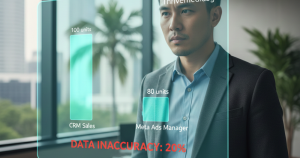
However, frequency alone isn’t enough. You must pair it with Engagement Decay. Look at your ad’s Click-Through Rate (CTR) and Conversion Rate (CVR). A winning ad might start with a 2.5% CTR and a low S$50 Cost Per Click (CPC). When that CTR drops to 1.5% and the CPC climbs to S$80, even if the CAC hasn’t fully imploded yet, the creative is showing signs of death.
Actionable Insight: Set up an alert to flag any creative where the 7-day average frequency exceeds 4.0 and the CTR has dropped by 30% from its initial 7-day peak. This is your early warning. For a deeper dive into conversion metrics, understanding the difference between Offline Conversions and Conversions API is vital for accurate tracking, which you can read about here.
For businesses targeting smaller, high-value niches, particularly in Singapore’s B2B space or high-ticket services, Audience Saturation becomes the critical keyphrase. This is where a significant percentage of your available audience has already been reached.
If you’re running campaigns for “Google Ads for B2B” (a high-cost Singapore industry) targeting a pool of only 50,000 users, reaching 80% of them means the well is nearly dry. Adding more budget just means showing the same ad to the same people more aggressively. A drop-off in new leads acquired daily, even with stable ad spend, is a strong saturation signal.
Real-World Benchmark: A B2B training provider in Singapore we worked with experienced a 120% spike in their Cost Per Lead (CPL) when their campaign reached 75% of a highly niche B2B audience in just six weeks. The solution wasn’t budget reduction, but an urgent creative refresh.
Once fatigue is detected, you don’t instantly kill the ad. Instead, you enter the Creative Refresh Cycle. This systematic process extends the ad’s life and minimizes downtime in your profit-generating campaigns.
Rethreading involves changing the least disruptive elements of your ad. It keeps the core “winning” idea but introduces novelty.
If rethreading fails, remixing changes the delivery format while keeping the key message.
This is the final step. The original ad is paused (or moved to a low-budget retargeting campaign), and a completely new creative concept is launched.
Connect with our expert team with proven digital marketing strategies that deliver real results.
Connect with us! →Many SMEs and even larger firms in Singapore make a crucial mistake: they treat Creative Fatigue Detection as a back-end tracking problem instead of a front-end production priority.
The common trap, particularly in high-CPC industries like local property, education, and financial services, is the failure to recognize that local ad costs are inherently higher due to the dense, competitive nature of the Singapore market.
“In Singapore, a high-intent keyword on Google Ads can easily hit S$15-S$30 per click. You simply cannot afford to waste those expensive clicks on a fatigued ad. Yet, we frequently see local businesses running the same polished, high-production creative for six months straight. This is financial suicide in a high-cost environment like ours.” – (Expert Opinion, Thrive Media Singapore)
The fix is integrating high-velocity creative production into the budget. The Cost of Goods Sold (COGS) for your advertising should include the cost of constantly generating new, differentiated creatives. This is the only way to sustainably scale using a Broad Targeting Strategy.
Our findings align with global industry research. For instance, studies by platforms like Facebook (now Meta) have consistently shown that ad creative accounts for over 70% of campaign performance, far outweighing targeting or bidding strategy. A 2024 analysis by HubSpot noted that the lifespan of a top-performing creative has shrunk to under 45 days in saturated markets. This pressure emphasizes the urgency of a systematic refresh framework.
This framework on fatigue detection is a vital tactical component of the larger Creative-Led Growth strategy. If the creative is the engine of your growth, then fatigue detection is the maintenance schedule. Without a proactive system for managing the lifespan of winning ads, even the most robust data-driven tracking (like that achieved with Meta Server Side Tracking and CAPI) will only tell you why you failed, not help you prevent it. Sustainable growth requires treating creative assets as perishable goods with a defined, limited shelf life.







Our team consists of seasoned digital marketers, bringing years of hands-on expertise driving results for SMEs and enterprises throughout the APAC region.
from first click to final sale, across Meta, Google, TikTok, YouTube, and your CRM so you can see what’s working and what’s not.
Your videos, landing pages, ads, and data are aligned under one strategy no more juggling vendors.
Budgets shift based on real-time performance, not monthly meetings.
Leads and traffic you already have get optimized for higher ROI and less waste.
Clear reports, honest feedback, and no jargon, even when results aren’t perfect.
Digital Marketing isn’t just about running ads. It’s about turning data into visible growth.
Creative Fatigue (Singapore Focus)
The optimal frequency often sits between 2.0 and 4.0 over a 7-day period. For smaller audiences in Singapore’s niche B2B sectors, a frequency over 4.0 consistently shows a sharp drop in CTR and a significant rise in Customer Acquisition Cost (CAC), signaling the onset of creative fatigue. [Image illustrating the creative fatigue curve showing initial high CTR/low CAC, the peak, the decay phase marked by rising frequency and dropping CTR, and the required creative refresh point]
Monitor the daily or weekly change in two key metrics: Click-Through Rate (CTR) and Cost Per Click (CPC). A 25% drop in CTR coupled with a noticeable rise in CPC for a winning ad is the earliest warning sign of imminent creative fatigue, even before the final conversion metric (CAC) explodes.
Yes, moving a fatigued ad to a retargeting audience (people who have previously engaged or visited your site) can be effective. Since this audience is already familiar with your brand, the ad’s high frequency is less detrimental. However, ensure the ad is updated to a more direct-response offer.
For actively scaling campaigns, especially in competitive Singapore industries, aim to test and launch 3 to 5 completely new creative concepts per month. A high creative production velocity is necessary to ensure you always have a non-fatigued replacement ready to maintain a stable Max Profitable CAC.
A/B testing is essential for managing creative fatigue. By continuously testing new creatives against the current winner, you can identify the next winner before the current one’s performance decays, ensuring a seamless transition and maintaining low Customer Acquisition Cost.
Create a Creative Asset Library that breaks down winning ads into their core components: Hook, Body/Proof, and Call-to-Action. Document the key selling proposition. This structured approach allows your team to easily Remix and Rethread new variations when facing creative fatigue.
Singapore is a dense, highly competitive market with smaller, sophisticated target audiences. The same user is often hit by multiple advertisers frequently. This faster audience saturation means the time to detect and act on creative fatigue is severely compressed, necessitating a proactive refresh cycle.
No, an immediate kill is not recommended. The best practice is to first attempt a Rethread or Remix refresh, modifying the ad copy, headlines, or hooks. Only fully Replace the ad with a new concept if these micro-changes fail to reverse the engagement decay and rising acquisition costs.
The simplest and most effective way is to change the first three seconds, known as the hook. A strong hook accounts for a large portion of the ad's success. Use the same core message and body, but introduce a new visual or statement that resets the audience’s pattern recognition and fights creative fatigue.
Switching platforms temporarily delays the problem. While it exposes your creative to a new audience, the fundamental creative idea will eventually fatigue there too. The sustainable solution is a continuous creative refresh process, not platform migration.
When your ads hit severe creative fatigue, the campaign's performance becomes unstable. This instability feeds bad data to the platform's machine learning algorithm, prolonging the learning phase and making it harder for the algorithm to efficiently find high-quality leads, ultimately increasing your overall ad spend.

Your business deserves more. Let ThriveMediaSG help your business Increase Sales through digital marketing.
Creative Fatigue Detection is the proactive, data-driven process of identifying when a high-performing digital advertisement is beginning to lose effectiveness due to overexposure to its target audience. It is essential for modern marketing because creative performance, not just targeting, is the primary lever for scaling profitably post-iOS 14. If undetected, fatigue causes the Cost Per Click (CPC) and Customer Acquisition Cost (CAC) to spike uncontrollably, eroding profit margins. This framework is vital for e-commerce brands and B2B lead generation companies in competitive markets like Singapore.
Creative fatigue is the point where the audience has seen an ad so often that they become ‘blind’ to it, drastically lowering engagement metrics.
It is a function of time, audience size, and ad budget.
The effect is measurable by the decline in the Click-Through Rate (CTR) and a subsequent rise in Cost Per Mille (CPM).
In high-cost advertising environments, such as Singapore, every impression is expensive.
Wasting a $15-$30 CPC on a fatigued ad creative is highly damaging to the P&L.
Creative fatigue directly attacks the core profitability metric: your Max Profitable CAC.
When an ad fatigues, its ability to convert traffic efficiently disappears, making scaling impossible.
The Proactive Decay Model uses leading indicators to predict the failure point before the revenue charts drop.
Step 1: Frequency-Based Alerting. Set a soft threshold (e.g., 7-Day Frequency of 4.0 on Meta) to flag the creative for review.
Step 2: Engagement Decay Validation. The true signal is the combination of high frequency and a $\ge$ 20% drop in CTR from the ad’s peak.
Step 3: Systematic Refresh (The 3-R Framework). Once validated, the creative is moved into a pre-defined refresh pipeline: Rethread (copy/headline change), Remix (hook/format change), or Replace (entirely new concept).
The common mistake is to “kill” a winning ad the moment performance dips.
Contrarian Insight: Never kill a winning ad outright; instead, move it to a lower-budget, more specific retargeting audience where the high frequency is less of a barrier.
The ad’s core selling proposition remains effective for warm traffic; only the cold, broad audience has fatigued.
This transition allows the profitable elements of the creative to continue generating returns while freeing up the main budget for new, non-fatigued concepts.



Building Brands Since 2001
©2026. ThriveMediaSG. All Rights Reserved.