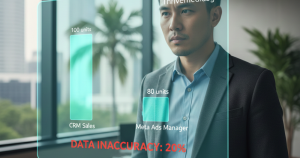
Are you tired of Google Ads optimizing for clicks and leads that never turn into cash? There’s a hidden lever that top-performing Singaporean businesses are pulling to transform their ad spend from a cost centre into a profit engine.
It’s not about more data—it’s about the right data.
The secret is importing your offline CRM sales back into Google to make the algorithm hunt for real revenue, not just vanity metrics. This guide will show you how to close the loop and finally get your ads to work for your bottom line
we shares analysis, strategies on digital marketing everyday.
This service is not intended for persons residing in the E.U. By clicking subscribe, I agree to receive news updates and promotional material from Thrive Media SG
Imagine spending $10,000 a month on Google Ads for your SME in Singapore. The dashboard looks great: 500 leads, a Cost-Per-Lead (CPL) of $20, and a healthy click-through rate.
But your sales team closes only 20 of those leads. Suddenly, your real Customer Acquisition Cost (CAC) isn’t $20—it’s $500. This is the brutal reality of the attribution gap.
Most businesses in Singapore, from high-ticket B2B services to premium enrichment centres in Bukit Timah, are flying blind.
They optimize for what they can see online—clicks, form submissions, calls—while the true value, the *offline conversion* (the signed contract, the paid invoice, the enrolled student), lives isolated in their CRM like HubSpot or Salesforce.
By bridging this gap, you instruct Google’s AI to stop chasing cheap leads and start finding customers who actually buy.
This process, known as **offline conversion import**, is the most significant upgrade you can make to your performance marketing. It moves you from guessing to knowing, as detailed in our framework on The 3 Metrics That Matter
Connect with our expert team with proven digital marketing strategies that deliver real results.
Connect with us! →Offline conversions are valuable actions that happen after an online interaction but are recorded outside of your ad platforms. For a Singaporean context, this includes:
* A sales call booked via a Google Ads lead form that results in a signed service contract.
* A brochure downloaded for a Tuition Centre in Bishan that leads to a student enrollment (often discussed by parents offline).
* A quote request from a Google Search ad that converts into a $50,000 B2B software deal in the CBD.
* A store visit direction click that results in an in-person purchase at a retail shop in Orchard Road.
Platforms like Google Ads and Meta Ads operate on machine learning. Think of them as a super-intelligent intern. If you only tell it, “Go get me form submissions,” it will find people who love filling out forms. But if you tell it, “Go get me form submissions **that turned into customers worth $2,000 each**,” it will completely change its search pattern. It starts to discern the subtle signals and intent patterns of high-value users versus window-shoppers.
A study by MarketingProfs highlights that businesses using offline conversion tracking see, on average, a 15-25% improvement in cost-per-acquisition (CPA) because the algorithm can self-optimize with revenue intelligence. This is the core principle of Feeding the Meta Machine
In Singapore, where **Google Ads CPCs in competitive industries like finance, legal services, and premium education can easily exceed $15-50**, wasting budget on unqualified traffic is a fast track to negative ROI.
Offline conversion tracking isn’t a “nice-to-have”; it’s a survival tool. It allows you to compete not by outspending giants, but by out-smarting them with superior data. This is especially crucial for Google Ads for B2B
Before importing offline sales, you must correctly tag your online leads. This requires:

Your sales team’s CRM workflow needs a dedicated “Conversion” stage. When a lead becomes a customer:
* Update the lead’s status to “Won” or “Customer.”
* Crucially, input the final transaction value into a dedicated CRM field.
* Ensure the original GCLID is still attached to that contact record.
Scaling without precise knowledge of your true profitability is gambling. You need to move beyond simple ROAS and CPA and understand your lifetime value (LTV).
Are you focused on the vanity metrics agencies sometimes push, or are you tracking the core metrics that link back to business profit? Scaling the wrong metric is The #1 Ad Mistake 80% of SMEs Make (And How to Fix It Before Wasting More Money).
Actionable: Ensure you have a clear understanding of your current customer acquisition cost (CAC) and your target CAC.
If your current CPA is S$15 and your Max Profitable CAC is S$30, scaling is viable. If your CPA is S$25, scaling by 20% may immediately push you into the unprofitable zone. Know your numbers first.
Don’t just import one “Sale” conversion. Create segments based on value bands. For example:
* Conversion Action 1: *Sale_Under_$5k*
* Conversion Action 2: *Sale_$5k-$20k*
* Conversion Action 3: *Sale_Over_$20k*
This allows you to create Smart Bidding strategies (like Target ROAS) that specifically aim for high-ticket clients, a tactic explored in our article on Automation for High-Ticket
Your business deserves more. Let ThriveMediaSG help your business Increase Sales through digital marketing.

Challenge: High CPCs ($8-12) for keywords like “best international preschool Singapore.” Flooded with inquiries from parents just starting their research, stretching admissions staff thin.
Action: Implemented offline conversion tracking. Imported “School Tour Completed” and “Enrollment Confirmed” as separate conversions, with enrollment valued at $30,000 (annual fee).
Result: After 60 days of learning, Google’s algorithms shifted. While overall lead volume dropped by 20%, **tour-to-enrollment conversion rate increased by 45%**. They achieved a **32% lower cost-per-enrollment** by letting Google learn which click paths led to serious parents, not just curious ones.
* Challenge: Generating “demo requests” for a $5,000/yr product. High lead volume but low sales close rate from marketing-qualified leads.
* Action: Connected Salesforce to Google Ads. Imported “Opportunity Created” and “Contract Signed” conversions.
* Result: Switched to a Target ROAS (Return on Ad Spend) bidding strategy. The system began to prioritize users whose behavior mirrored past customers.
Over one quarter, they increased signed contract volume by 35% while reducing ad spend by 15%, effectively practicing Max Profitable CAC
According to a Search Engine Land report, companies that successfully implement offline conversion tracking can improve their quality score and see up to a 10% reduction in CPCs over time, as Google rewards advertisers with higher-quality conversion data.







Our team consists of seasoned digital marketers, bringing years of hands-on expertise driving results for SMEs and enterprises throughout the APAC region.
from first click to final sale—across Meta, Google, TikTok, YouTube, and your CRM so you can see what’s working and what’s not.
Your videos, landing pages, ads, and data are aligned under one strategy no more juggling vendors.
Budgets shift based on real-time performance, not monthly meetings.
Leads and traffic you already have get optimized for higher ROI and less waste.
Clear reports, honest feedback, and no jargon—even when results aren’t perfect.
Digital Marketing isn’t just about running ads—it’s about turning data into visible growth.

This section answers the critical “what not to do” questions frequently searched online.
The Trap: Importing sales data once a month. The algorithm needs fresh, frequent data to learn. A daily automated sync is non-negotiable.
The Fix: Use automated workflows via Zapier or Make.com to ensure CRM data feeds into Google Ads daily.
The Trap: Uploading personally identifiable information (PIE) like names or email addresses directly. This violates platform policies.
The Fix: Only hash (encrypt) accepted identifiers like GCLIDs or email addresses before upload. Always comply with Singapore’s **PDPA**. Use the official secure import methods provided by Google.
The Trap: Only importing the final “sale.” This misses valuable intent signals from earlier stages.
The Fix: Implement a multi-step conversion hierarchy.
Import “Lead,”
“Qualified Lead,”
“Demo Booked,” and “Customer.”
This fuels a true Full-Funnel Sequencing
The Trap: Not adjusting value rules or attribution models post-setup.
The Fix: Regularly audit. If your average deal size increases, update your value bands. Test different attribution models to see which gives your strategy the most accurate steering signal.

Your business deserves more. Let ThriveMediaSG help your business Increase Sales through digital marketing.
Offline conversion tracking is the technical process of sending sales data from your CRM back into Google Ads. It matters because it shifts the algorithm’s goal from generating leads to generating customers. This article is for business owners, marketing directors, and performance marketers in competitive, high-CPC markets like Singapore who are tired of wasted ad spend and want to scale profitably
It is a data bridge. It connects two isolated systems: your advertising platform (Google Ads) and your customer system (CRM). The bridge carries one key piece of information: which specific ad click led to a sale, and how much that sale was worth.
Apple’s privacy updates broke traditional tracking, making platform-reported conversion data less reliable. Feeding first-party sales data from your CRM back into Google Ads restores signal. It is now the primary method for accurate attribution and profitable bidding.
How does it work technically?
Implement offline conversion tracking immediately if: your product/service has a value over $500; your sales cycle involves offline steps (calls, demos, contracts); or you are using Google Ads for lead generation in a competitive industry.
This mental model has three components:
* Input: Ad Click (GCLID generated).
* Bridge: CRM Process (GCLID stored, sale recorded).
* Output: Algorithmic Optimization (Revenue data ingested, bidding adjusted).
The relationship is linear and causal. A break in the bridge causes the system to fail, optimizing for the wrong outcome.
The biggest mistake isn’t technical—it’s human. Companies focus on the tool setup but neglect the required sales team behavior change. If your sales reps do not consistently and accurately update the CRM with the correct GCLID and value, the entire system is garbage-in, garbage-out. The fix is process automation, not more training.
Because you feed revenue data (Cause), the Google Ads algorithm can distinguish between high-value and low-value click patterns (Effect). Therefore, it automatically shifts budget towards audiences and keywords that drive real cash (Outcome), directly increasing your advertising ROI.
Google Ads (Offline Conversions API), CRM (HubSpot, Salesforce), Automation Connectors (Zapier, Make.com, PieSync), Call Tracking (CallRail, Invoca).
Stop letting Google guess what a good customer looks like. By importing your CRM sales data, you give the algorithm a direct blueprint: ‘This is the person who pays us. Find more of them.’ This changes everything from keyword bidding to audience targeting, turning your ad account into a profit-centric system.
* Offline conversion tracking closes the loop between ad spend and actual revenue.
* It is essential for accurate attribution in a privacy-focused, post-iOS14 world.
* The core technical requirement is capturing and passing the Google Click ID (GCLID).
* Success depends 80% on process and 20% on tool setup.
* It enables Target ROAS bidding, the most powerful profit-optimization tool in Google Ads.
Frequently Asked Questions (FAQ) for Offline Conversions in Singapore
Offline conversions are valuable customer actions (like a signed contract or in-store purchase) that happen after an online click but are recorded in your CRM. Importing this data back into Google Ads tells the algorithm what a *valuable* customer looks like, moving beyond just tracking clicks.
With high CPCs in Singapore’s competitive market, optimizing for real revenue is crucial for survival. It ensures your limited ad budget targets high-intent users who actually buy, not just browse, maximizing your Return on Ad Spend (ROAS).
For most businesses with a consideration period (common in Singapore’s B2B and high-value services), **Position-Based attribution** (40% credit to first and last click) is a strong starting point as it honors both awareness and closing interactions.
Yes, if done correctly. Use hashed (encrypted) identifiers for upload and ensure you have user consent for data collection. The official import methods via Google and Meta APIs are designed for compliance.
Absolutely. Using **call tracking software** that dynamically assigns phone numbers to ads, you can capture a unique GCLID for each caller. When a call leads to a sale, that GCLID and sale value can be imported as an offline conversion.
Capture the Google Click ID (GCLID) when a lead submits a form. Store this ID in your CRM with the lead’s record. When the lead becomes a customer, upload the conversion data (with the GCLID and value) back to Google Ads via an automated daily sync.
Yes, using Facebook’s Conversions API (CAPI). Similar to Google, you can send lead qualification and sale data from your CRM back to Meta, improving lead quality and reducing cost per qualified lead. We detail this in **[Feeding the Meta Machine](https://thrivemediasg.com/using-capi-to-send-deep-data-back-to-ad-platforms/)**.
Allow a **2-4 week learning period** after import for Google’s Smart Bidding algorithms to process the new data and adjust. Patience is key; do not make drastic changes during this phase.
Major CRMs like **HubSpot, Salesforce, and Zoho CRM** have built-in or well-documented integrations with Google Ads Offline Conversions. The choice depends on your business size and complexity.
Enhanced conversions use hashed customer data (like email) from your website to improve *online* conversion measurement. Offline conversions import data from *outside* your website (your CRM/sales team). They are complementary and should be used together.



Building Brands Since 2001
©2026. ThriveMediaSG. All Rights Reserved.